Posts

Amazon Web Services

Image
AWS On-Demand Instance: AWS On-Demand Instance (Amazon Web Services On-Demand Instances) are virtual servers that run in AWS Elastic Compute Cloud(EC2) or AWS Relational Data base Service (RDS) and are purchased at a fixed rate per hour. AWS recommends using On-Demand Instance for application with short-term, irregular workloads that cannot be episodic. They are also suitable for use during testing and maturity of applications on EC2. AWS ec2 Instance are designed for different tasks within the cloud. On-Demand Instances have no bond pledge AWS EC2 Instance are presented in a variety of different levels of compute power and and can be launched as needed -- except potentially during periods of very high compute demand in particular availability zones. This is usually the most classy purchasing option for AWS instances, though exact hourly prices vary depending on the operating system and size of the instance. Each On-Demand Instance is billed per instance hour from time it is...
Scheduled Instances

Image
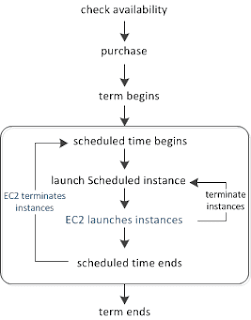
Scheduled ReservedInstances (Scheduled Instances) allow you to purchase faculty reservations that recur on a daily, weekly, or monthly basis, with a particular start time and length, for a one-year term. You reserve the capacity in advance, so that you know it is available when you need it. You pay for the time that the instances are scheduled, even if you do not use them. ScheduledInstances are a good choice for workloads that do not run continuously, but do run on a regular schedule. For example, you can use Scheduled Instances for an application that runs during business hours or for batch processing that runs at the end of the week. If you necessitate a ability condition on a incessant basis, Reserved Instances might meet your needs and decrease costs. For more information, see scheduled instances If you are flexible about when your instances run, Spot Instances might meet your needs and decrease costs. How to scheduled instances: Amazon EC2 sets aside pools o...
Image
AWS On-Demand Instance: AWS On-Demand Instance (Amazon Web ServicesOn-Demand Instances) are virtual servers that run in AWS Elastic ComputeCloud(EC2) or AWS Relational Data base Service (RDS) and are purchased at afixed rate per hour.AWS recommends using On-Demand Instance for applicationwith short-term, irregular workloads that cannot be episodic. They are alsosuitable for use during testing and maturity of applications on EC2. AWS ec2 Instance are designed for different tasks within the cloud. On-Demand Instances have no bond pledge AWS EC2 Instance are presented in a variety of different levelsof compute power and and can be launched as needed -- except potentially duringperiods of very high compute demand in particular availability zones. This is usuallythe most classy purchasing option for AWS instances, though exact hourly pricesvary depending on the operating system and size of the instance. Each On-DemandInstance is billed per instance hour from time it is launched un...

Reserved Instance

Image
Reserved Instances provide you with a significant discount compared to On-Demand Instance pricing. Reserved Instances are not physical instances, but rather a billing discount applied to the use of On-Demand Instances in your account. These On-Demand Instances must match certain attributes in order to benefit from the billing discount. The following diagram shows a basic overview of purchasing and using Reserved Instances. In this scenario, you have a running On-Demand Instance (T2) in your account, for which you're currently paying On-Demand rates. You purchase a Reserved Instance that matches the attributes of your running instance, and the billing benefit is immediately applied. Next, you purchase a Reserved Instance for a C4 instance. You do not have any running instances in your account that match the attributes of this Reserved Instance. In the final step, you launch an instance that matches the attributes of the C4 Reserved Instance, and the billing benef...

FLEXIBLE CLOUD HOSTING SERVICES

Image
You have the choice of numerous instance types, operating systems, and software packages. Amazon EC2 allows you to select a design of memory, CPU, instancestorage, and the boot divider size that is best for your choice of operating system and application. For example, choice of operating systems includes numerous Linux distributions and Microsoft Window Services.

Amazon Web Services

Image
Amazon EC2 Auto Scaling:   Amazon EC2 Auto Scaling helps you ensure that you have the correct number of Amazon EC2 instances available to handle the load for your application. You create collections of EC2 instances, called Auto Scaling groups. You can specify the minimum number of instances in each Auto Scaling group, and Amazon EC2 Auto Scaling ensures that your group never goes below this size. You can identify the most number of instances in each Auto Scaling group, and Amazon EC2 Auto Scaling ensures that your group never goes above this size. If you specify the preferred capacity, either when you create the group or at any time thereafter, Amazon EC2 Auto Scaling ensures that your group has this many instances. If you specify scaling policies, then Amazon EC2 Auto Scaling can launch or finish instances as demand on your application increases or decreases. For example, the following Auto Scaling group has a minimum size of one instance, a desired capacity of two instances...

Elastic Web Scale Computing

Image
Amazon EC2 enables you to increase or decrease capacity within minutes, not hours or days. You can commission one, hundreds, or even thousands of serves instances simultaneously. You can also use Amazon EC2 Auto Scaling to maintain availability of yours EC2 fleet and automatically scale your fleet up and down depending on its needs in order to maximize performance and minimize cost. To scale multiple services, you can use AWS Auto Scaling.